

Thanks to its thermal conductivity, workability, corrosion resistance and compatibility with refrigerants and synthetic oils, copper is the reference material for HVAC plants and for commercial and industrial refrigeration.
In the European scenario, refrigeration copper tubes usually comply with the following standards:
- EN 12735-1 → Seamless copper tubes for refrigeration and conditioning
- EN 12735-2 → Pre-isolated system copper tubes
- PED 2014/68/UE Euroepan directive (pressure equipment)
But for civil and commercial HVAC applications, it is important to comply also with:
- Insulation reaction to fire (EN 13501-1)
- Energy efficiency requirements (UE Ecodesign Regulation)
In this fields there are two main categories of copper tubes:
- Bare copper tubes made of deoxidized copper (Cu-DGP). It ensures the best flexibility in the choice of the insulation thickness when needed
- Covered copper tubes (insulated or with protective casing)
The choice of one of the two types influences:
- The energy efficiency
- The plant durability
- The regulation compliance
- The installation costs
- The maintenance
All these are the reasons why engineers and installers usually have a question: is it better to use bare copper tubes or covered copper tubes? There is not an univocal answer since it depends on working conditions, on the installation site and on energy efficiency purposes.
The choice of a tube is not merely an initial costs issue, but it is a problem of long-term performance and maintenance and it depends on the context in which the tubes have to be installed. Bare copper tubes guarantee more flexibility and opportunities of inspectability with real-time leak and corrosion detection; covered copper tubes guarantee better energy performance, long-term protection and fast installation.
When choosing between the two options, 4 main factors have to be considered: fluid temperature, place exposure, level of inspectability, design approach. In case of a standard approach it’s better to choose covered copper tubes; in the other case bare copper tubes can be used and if requested atailor-made insulation layer can be designed upon the tube.
Let’s see the main differences
Bare copper tubes are more suitable for internal and inspectable context, for industrial applications or in case of tight budget.
The covered version is preferred in case of external installation, wet and marine environments, residential split-type air conditioners and suction lines.
In modern highly efficient HVAC plants, the actual trends moves towards certified pre-isolated tubes; while in case of complex industrial plants, the best solution is often a tailor-made design using bare copper tubes to which a technical insulation is applied later during installation and set up.
There are three main kinds of coating:
- Pre-insulated tube with elastomeric and polyethylene foam
- PE, PVC or polyolefins covered copper tubes
- Twin system
In the current heating and refrigeration systems the choice and the quality of the insulation are crucial aspects to guarantee the certified performance of a plant.
As already said, thanks to their characteristics, covered copper tubes are particularly suitable for outdoor environments, naval and seawater exposed applications such as coastal areas since it assures a higher protection against moisture, a reduced contact with alkaline substances and a longer life that is particularly important in case of aggressive contexts.
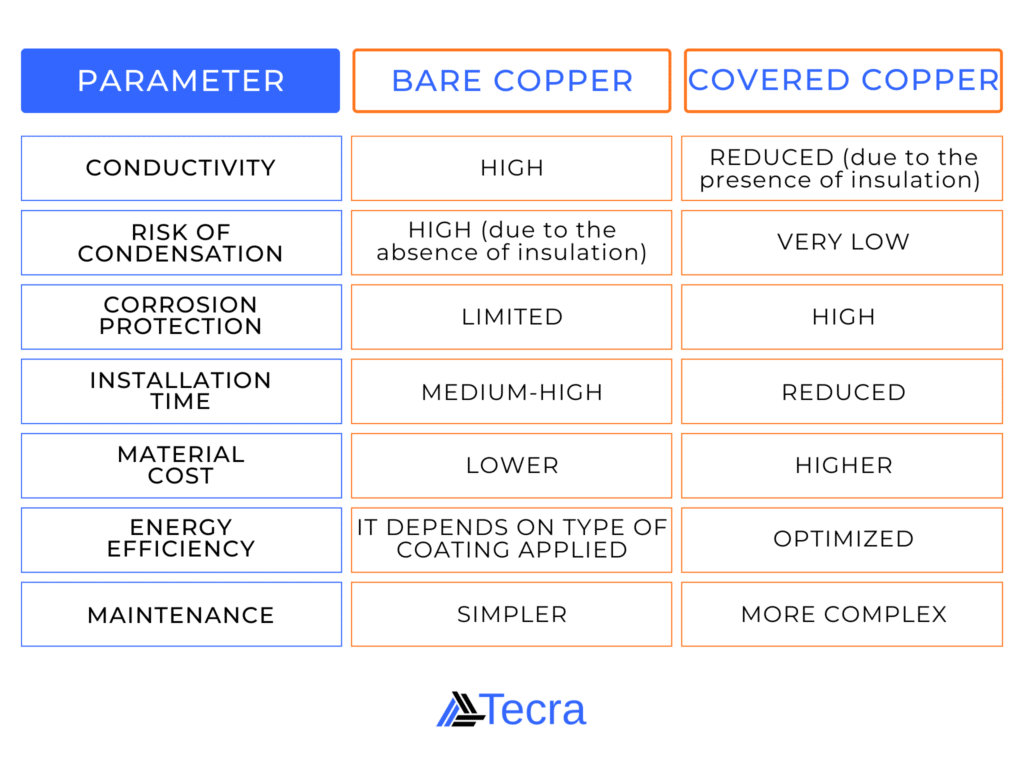
With reference to covered copper tubes, there are two additional critical factors to consider. The first one the risk of damage of the insulation during the setup and the second one is a reduced visual inspection. Furthermore, in case moisture seeps under the sheath, a corrosion phenomenon will start without the possibility to detect it.
Comparison between bare copper and covered tubes
Applications for bare copper tube:
- Refrigeration plants and indoor technical rooms. In these cases, the insulation is used only in some circumstances for instance for suction lines
- High-temperature lines using an insulating sheath to avoid premature insulation wear
- Complex industrial facilities with intricate piping network
- Food and pharmaceutical plants where the inspectability factor is crucial
- Bare copper tubes allows a direct visual inspection of the surface
Applications for covered copper tubes:
- Low temperature suction lines
- Commercial refrigeration
- Outdoor installations also in aggressive contexts
- In-wall piping
Briefly and generally speaking it can be said that in case of refrigeration plants, inspectable and tailor-made industrial plants the choice of bare copper tubes is preferred with the addition of technical insulation in the setup phase, if requested; on the other hand in case of residential, commercial plants or external application covered copper tubes are more suitable.
It is clear that there is not the best solution a priori; there is rather the most suitable solution for the context in which the tube has to be used considering the fact that in the long-term the right choice influences processing costs and the end user satisfaction.
Tecra is able to support you in the choice of the best suitable kind of copper tubes for your projects with certified solutions.